To my
amazement, embroidery is finding a role beyond fashion, beyond craft, beyond
museums. Companies and organizations, with no affinity to needlework at all,
are choosing embroidery as a medium to communicate. Yes, they are sending us
subliminal messages through embroidery. And before you ask, I haven’t been
drinking.
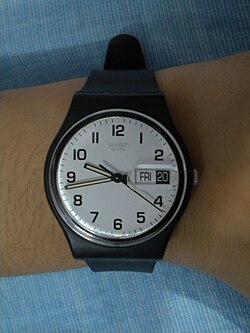 |
| A Swatch |
Out
Christmas shopping, I passed a display at Swatch, that plastic digital watch
loved by trendy teens. The shop’s window was decked with snowmen,
cross-stitched in white on a red back ground. They created a backdrop for the display
cases, filled with funky timepieces. Sure, the figures in XXX’s had been
computer-generated to simulate embroidery. I was not being fooled.
Yet for me
the question was why simulate embroidery? Heaven knows chocolate-box pictures
of Swiss alpine villages might have worked too.
What qualities was this techie company trying to get across that it
could best by suggesting embroidery? Tradition? Embroidery does have a long
tradition, longer than Swiss watches. Craftsmanship?
Do they want us to overlook the synthetic materials and industrial process need
to mass produce plastic watches? Embroidery does conjure up “the handwork
quality” to non-stitchers. Well, that is what I read into what I was seeing. But
then I’ve got embroidery on the brain. Overall, the hidden messages, reaching
me for one, were positive.
Now, HBR is not a periodical one
finds in the arts and crafts section of a news-stand. It is a very serious
journal, widely read by the captains of industry and those waiting to join the
ranks. So if any organization is mindful of Marshall McLuen’s adage “the medium
is the message”, it’s this lot.
Just click here to see the image I mean.
To my astonishment, the HBR website
displayed a piece of needle work. I kid you not. The editor chose to promote an article entitled
HBR
“The Big Lie of Strategic
Planning” by Roger L. Martin with a pseudo-sampler beautifully
stitched by Nicole de Vries. A message overlaying the embroidery reads “A detailed
plan may be comforting, but it's not a strategy.”
The HBR embroidery is a
spoof on a traditional sampler style and a take off on “Home Sweet Home.” The
hearts and stylized flowers are meant to telegraph conventional wisdom of yesteryear.
Strategy is not enough in contemporary
business.The HBR may be right about
business. Maybe detail, care, plan, and comfort
do not cut it if you want to get ahead in corporate life. However, as an
embroiderer, I found their illustration with its overlay most unfortunate.
The negatives in the message
I picked up on were: needlework, just
like strategy, is old-fashioned,
useless, and outmoded. The graphic’s qualities may reinforce the article, but, in
the process they belittle needlework, and samplers in particular, which require considerable
attention to detail, persistence, and careful planning.
How unfortunate for a male-dominated business school to pick a quintessentially female form of art and expression
to emphasize negative qualities. The Harvard crowd maybe at the fore of
business thoughts, but, when it comes to needlework they sure are stuck in
stereotypical thinking, which is precisely what they abhor. How ironic.
Thank goodness for more hip
publications like Wired and the New York Times.
Both have cottoned onto the work of thread-graphic designer Evelin Kasikov.
She revamps traditional
cross-stitch and other straight stitching techniques to introduce to a wider
public the possibilities of needlework in a digital age.
 |
| Typography by Evelin Kasikov published in Wired Magazine |
Despite using a traditional
medium, let’s face it thread is an old medium, the subliminal
message of the Kasikov’s work is that embroidery, done her way, is in step with
the computer generation. Evelin builds
on the positives of
traditional needlework –
care and precision - and smashes through the widely- held negative
preconceptions sticking to needlecraft such as repetitive and unoriginal.
And it sure doesn’t hurt her
embroidery’s allure that it appears next to a name brand Swiss watch.
I cheer on Evelin’s
success. She is making inroads in the world of advertising as well. Have a look at the logo she created for the women’s
line of Nike sportswear which should go on sale in January 2014. How wonderful that
hand stitching is aligned with young women, vigorous, active, and “with it.” . But you can see more on her site.
 |
| Nike logo produced by Evelin Kasikova for line of women's wear |
Sure the Nike design, like the
snowman in the Swatch display, will be produced mechanically. Never the less
the logo is likely to retain that worked-by-hand quality.
Although Evelin came to hand
stitching less than a decade ago, she is doing a fabulous things to modernize the
image -- graphic and PR - of stitching. In her work, the medium is the message,
too. For once, both are modern and positive. Needlework can appeal to the
young, as Evelin is showing us. Embroidery can survive in the digital age.

