Tuesday, 23 September 2014

Mary, Mary, Quite Extraordinary, How does your needlework show?


Back when winter winds blew, I stumbled across a Tate Britain press release. In summer 2014, the Museum planned an exhibition explaining the history of craft in Britain. The display would include needlework by one Mary Linwood. Mary Who? 

Wikipedia  and a scholarly blog-post by Meg Andrews, formerly of Sotheby’s, banished my ignorance and made up my mind. Any excuse to hop from Amsterdam to London will do, but for me, the embroiderer, this one was irresistible.
Mary Linwood (1755–1845) was a hugely successful and renowned needle artist from Leicester. In her day, she stitched some 100 large-scale crewel embroideries. She unabashedly copied the oil paintings of celebrated contemporaries, like Joshua Reynolds, Thomas Gainsborough, and George Stubbs and religious canvases by Italians, including Raphael.

In 1789, the” Society for encouraging  of arts”, a precursor of today’s Royal Academy, awarded her a medal for “excellent imitations of pictures in needlework.” 
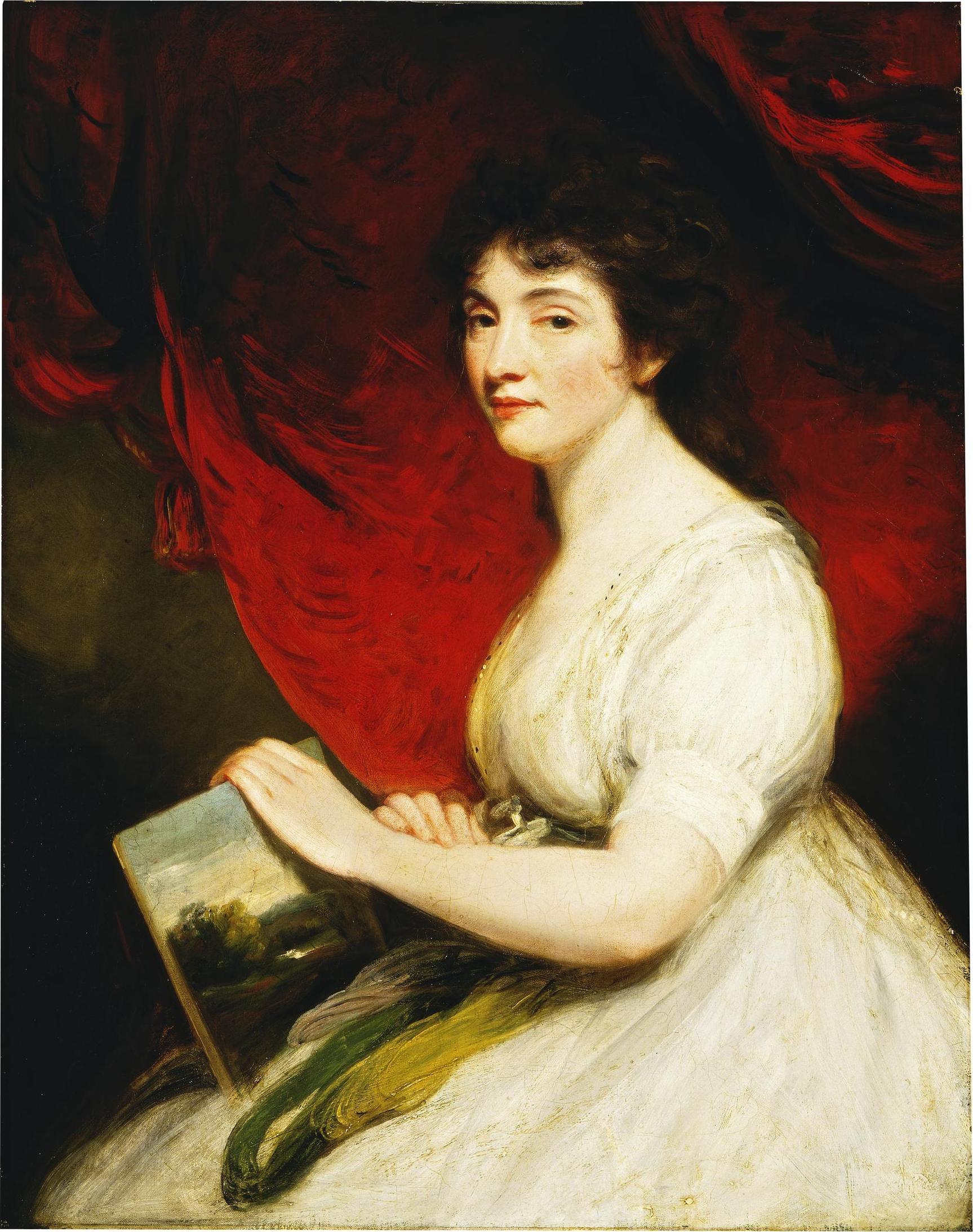
Mary Linwood by John Hoppner
Aged 20, Linwood moved from Leicester to London, setting up exhibitions to show her work, eventually setting up a permanent exhibition  in Savile House on Leicester Square.  Mary became affluent enough to commission John Hoppner to paint her portrait, after which she rendered it a “selfie” in yarn.
 
Linwood’s landscapes, still lifes, and portraits in wool toured Europe. They were praised, and prized,  by British and Continental aristocracy, including  Britain's Queen Charlotte and the King of Poland. In 1783, Catherine the Great of Russia reputedly offered £ 40,000 for Linwood’s entire collection, an offer the artist declined.

Another account of Mary's  Russian venture tells of a single picture being presented to the Tsarina, who commanded it be bought. The nobleman in charge of the purchase died before the agreed £ 3,000 was paid. Sadly, no one dared mention the deceased’s name, or anything associated with it, to the distraught empress. Therefore, Linwood’s needlework picture remained in Russia, unpaid for. Presumably, it is still there, somewhere.

To put Mary Linwood’s commercial success into context,  Catherine the Great’s offer equaled £4.2 million in  today’s  purchasing power. Indeed, the amount claimed for the single work, £315,000 today, would put Linwood on par with Banksy. And imagine, I had never heard of Mary Linwood. 

The art world can be fickle. Masterpieces of one year are banished to attics or sheds, awaiting rediscovery at car boot sales. After her death, Christie’s auctioned Mary Linwood’s remaining embroideries for £300 pounds, still a whopping £25,900, today. Thankfully, the canvases have found their way into the collection Victoria and Albert Museum (V&A) and the Leicester City Museum .
With this background information crammed into my head, one Sunday morning in August, I headed off to Tate Britain to see Mary Linwood’s work, not online, not on print, but in situ. The real deal.
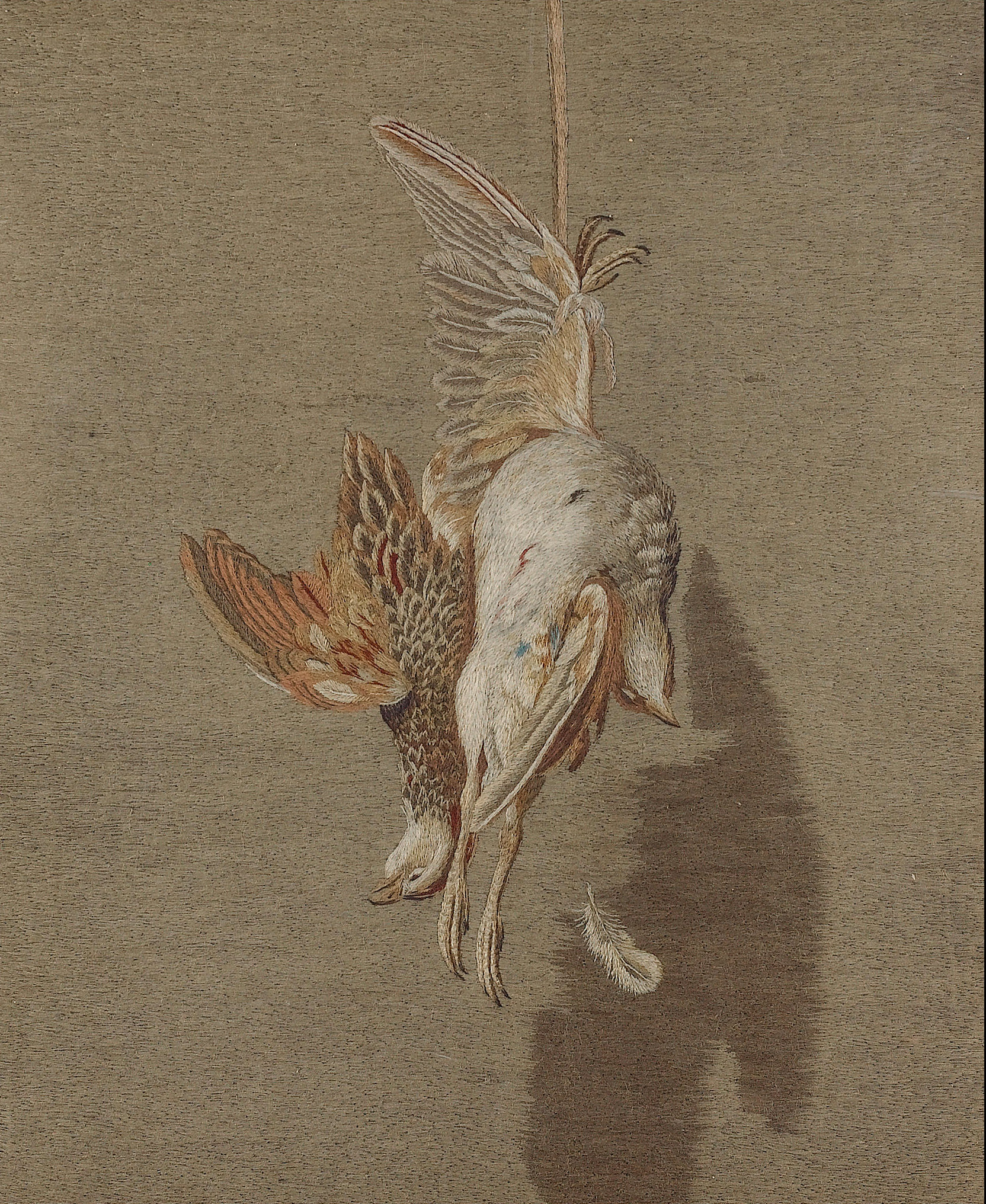
 
Hanging Partridge by Mary Linwood
As a needle painter of portraits, I was very intrigued to discover for myself  how Mary Linwood approached background, stitching direction, and shading. How realistic was her figurative work? How had she balanced the classic techniques of needlework with the demands of figurative art?

I make this point because some contemporary needle painters whom I have come across are not interested in stitching “classically” or “neatly.” Effect and image are paramount to them. In my own work, I try to reconcile image with stitching “tradition.” Neither approach is right, neither is wrong. It is the artistic difference, for example, between Ingres and -- here I go again -- energetic Van Gogh or Matisse. It‘s about what pleases the eye of the of the stitcher and viewer.

Cutting to the chase, I can tell you I was startled by what I saw. Linwood’s canvases  hung in a corner galley, separated from the ships’ figureheads, quilts, and straw work. Dimly illuminated, undoubtedly to protect them, the portraits looked ethereally pale. Maybe my impression was jaded by the bright colors of wools  available today. Linwood's yarns would be colored by natural materials, making them less vibrant than today’s artificial dye.

There was absolutely no doubt that Linwood's  images might be created in anything but yarn. There was no illusion of pencil or pastel, let alone aquarelle or paint. They were "robust".  l understand Linwood's choice of  wool. It had several advantages. Its softness made blending stitches easier. Its denier made covering canvas quicker than fine silk or cotton. Moreover, wool was likely to have been less expensive thank silk.

Linwood relied on cream wool to render flesh, adding maybe a bit of rose for blush. The skin on her subjects looked dingy. Could the dyed yarns have faded in the intervening 200 odd years since she stitched them? (Copes at the V&A stitched in silk over 500 years ago are still vibrant.) Had London’s famed smog gotten to them? Or maybe I needed to remember that women  used  face power liberally to appear like porcelain. Whatever, This left the portraits, as I saw/experienced them, ghostly and missing dimension that the tone can create.  Clothing was stitched in indigo and chocolate browns. The palette lacked the depth and vibrancy of paint or pastel by a long shot.  

Nevertheless, Linwood did render facial topography well. I recognized her technique of using swirls of precise stitches over the cheekbones and across the nose to create interest and depth in a face. And diminutive precise stitches rendered the eyes, complete with light flecks. The surface the she created was even.  In addition, there were longer stitches for the background to hurry the work to completion.  The stitching was lovely. Yes, Mary had approached the problem of rendering figures much as I had taught myself to do. 

Mary Linwood could draw well. As we see  she transferred an accurate cartoons faithfully onto linen cloth for stitching. Her figures and images were excellently proportioned. I cannot draw, but am blessed with technological advantages. I can print my subjects onto silk. What’s more, I can choose from 400+ colors of cotton or silk.  As I work, I stare at a computer screen, which enlarges any area I struggle to understand.  I wonder how much access Mary Linwood had to the pictures she was replicating. More than likely, she encountered them in the houses of people in her social circle. Still, I doubt she could camp in someone’s study for weeks or months, surrounded by stitching paraphernalia. No, she would need to work from sketches and memory. That she produced such faithful work under these circumstances is remarkable. Maybe Linwood had a photographic memory. I wonder if she had a clutch of helpers to do boring backgrounds.

What I found most unsettling was my response to the Linwood work. I appreciated it, but I did not like it.  That reaction startled me. Granted, the subject matter was dated. Then so were the baroque designs in silk elsewhere in the exhibit. In fact one of the most interesting, and beautiful things I saw as an embroidered map of an estate property. It was colorful, it was clever, and it was a copy. So why did I like it and not Linwood’s work? I am still pondering that question. 

Perhaps it is because Linwood’s work led me to understand why some subjects are not smitten by my early portraits. I get it now. My first ones are “neat and correct”, but they don’t “live”. They reflect little about my subjects. The portraits are emotionally neutral and, to boot, they are “pale,” almost 
ethereal, ghostly. This saps them of “realism.” Or is it “life?”

It amazed me that I could admire everything that Mary Linwood had achieved personally,  commercially and technically, but I still was not drawn to her work. I am glad it has  a home in the V&A Museum. The pieces are important on many reason.  Consider what they tell us about Mary Linwood as a person and entrepreneur. She achieved international acclaim without Facebook or internet. She openly copied the works of major artists of her era and was commended for it by the analog of the Royal Academy. (How amazing is that today, when copyright issues are made so much of.)

The medal Linwood received read: “EXCELLENT IMITATIONS OF PICTURES IN NEEDLEWORK.” So maybe it’s that imitation that got to me. For me, Linwood's works do not stand on their own. Clearly they did for her contemporaries. The needlework imitates the subject of painting cleverly.  And perhaps that is why, after a comet of a career, she is remembered in a craft exhibition for technical prowess, and not an artistic retrospective. I found that  sobering but instructive.

PS Added; April 2015

A UK visitor to The BBC's Antinques Road show broadcast last night, brought along picture by Mary Linwood.  It was valued at 3,000-4000 UK pounds.


Thursday, 7 August 2014

Never say Never


Technology moves at break-neck speed, or so it seems to me. As recently as May 2014, I smugly predicted that hand-embroidery was “safe” from the tentacles of technology such as 3-D printing, which enables painters/artists to replicate both the image and structure of their work.  Well as far as I can tell, embroidery is still unscathed, but there are developments.


Ingrida KazÄ—naitÄ—, a design student at from Kaunas, Lithuania, is creating a pen-like tool, which is intended to replace needle and thread in the repair of rips and tears. Her device also offers artistic possibilities, she believes. The wand would hold nano fibers in a solution and a scanner. Pass the tip over the rip to identify polyester or cotton fabric for color and structure, and then “ print” a patch from nano fibers to rejoin the edges of a tear. Her device is still “a work in progress”, but it is a finalist in the Electrolux design competition, which means the personal electronics industry sees merit in the idea.  
Miss KazÄ—naitÄ—’s  pen is based on a technology developed by Fabrican, a firm that generates garments by spraying particles of natural materials onto forms or people. Sewing and weaving techniques are nowhere to be seen. It’s quite mind boggling and certainly offers scope for artists and businessman. Have a look:

I can imagine that, in time, spray-on fabric could revolutionize the fashion industry --yet again. The number of thread and cloth manufactures would shrink. Robots, working round the clock, could replace sewing machine operators in sweat-shops, much as computer-controlled machines replaced mechanics in automobile factories. Will this new clothing be warm/cool, easy to clean, and recycle?  The fashion world and its technologist will undoubtedly work hard to convince us. They may even succeed, for some categories of clothing.

As for the future of the repair-fabric-pen, well I am less persuaded. I can foresee its utility once clothing is not woven, but sprayed.  But until then?  Electric shavers and depilatory devices have not replaced razor blades, although they have spurred manufactures to improve them. Stick-on bandages, now in plastic as well as cloth, sit on pharmacy shelves along with spray on band-aids.  And we all have gadgets that were once “oh so wonderfully exciting” now languishing in drawers and closets. Sure power mixers beat hand-whisks. And floor robots are better than vacuum cleaners, which are better than carpet beaters. But can you really improve a hand-needle, besides motorizing it?

I am not convinced that you need a machine for simple repairs, even if you are hopeless with needle and thread.  I have to hold up my hand to not always attacking minor disasters with needle and thread. In the past, when life was more hectic than it is today, I was known to repaired rips or drooping hems with scotch tape. Sometime I even stapled seams. Runs aka ladders in stocking got temporarily halted by drops of nail varnish.  Iron-on (irons..anyone remember that  ancient technology? ) patches camouflaged holes in jeans. Come to think of it, some new jeans come with holes and rips. It’s not even a problem anymore. That’s the ultimate solution.

Miss KazÄ—naitÄ—’s device will likely appeal to the techno-trendy, fashion-conscious generation, who has never worn items of clothing long enough for them to need repair. To be sure her device is an attractive, clever miniaturization of the bulky industrial sprayer in the video.  But I can't help feeling it is a solution looking for a problem. Am I a Luddite? Perhaps, but that’s how I see it through the eye of my needle.

Monday, 21 July 2014

Changing Times


Last week, across the Netherlands school bags dangled from flag poles above many front doors. This quirky habit broadcasts to the neighborhood that a kid has just graduated high school. It also signals the start of the school holidays, when families pack up and head off.


Flags are again flying In the Netherlands this week.  They hang at half mast on public buildings to memorialize the 193 Dutch men, women and children who had headed off to Asia, but died when their plane was shot down over the Ukraine by a missile.   

The Netherlands is a small country, just 17 million. There are cities in the world with larger populations.  Here suffering 193 dead is comparable to a loss of 4,100 lives in a country to size of the US.  So it was inevitable that I would know someone or know of someone who knew someone on board. And so it was. Within an hour a friend called to tell me she had lost a colleague who was traveling with children. Next a family member reported the same.  Thus a national – no international-- tragedy unfolding in some far off place quickly assumes the character of “up close and personal.”   This event has affected us all.

Thoughtful friends living abroad have called and written expressing their condolences. I don’t deserve them, thank goodness. My loved ones are safe and accounted for. But I accept these simple acts of kindness because we must foster kindness.  There is so much hate in the world. It swirls around like some invisible, toxic radiation.   It can reach 10 kilometers (35,000 feet) above the Earth’s surface to snuff out the lives of men, women, and children, who, oblivious to its existence, were just “passing through” on their way to do good or just have fun. 

I am old enough to remember a time when getting onto a plane was glamorous, even thrilling.  Into my hand luggage went an embroidery canvas, needles, thread and, yes, scissors, to while away the hours between Amsterdam and places my employer sent me.  Other women in the cabin knitted. How times have changed. And not for the better.  Sharp objects and many other things, too, are now banned on board as potential weapons. The list grows. I accept this as a necessary precaution. Yet, this week the fate of 300 souls on MH-17 demonstrated that despite all the technological improvements to aircraft, despite increased security precautions of all sorts, flying long haul is not a calculated risk, it is a deadly gamble.

Monday, 14 July 2014

Time Travel


This afternoon found me in New York City,  just minutes after leaving home! What a way to travel trans-Atlantic.  No jet lag, no airport hassles, just sheer enjoyment. And all for the price admission to my local art museum, which, until the end of August, has works on loan from New York’s Guggenheim Museum.
The museum's exhibition of Abstract Expressionism catapulted  me to Manhattan,  back  the 1950s when Mark Rothko, Jackson Pollock, and Karel Appel burst onto the Big Apple’s art scene. 
It presented several artists that I remembered from  visits to New York's iconic snail-shell museum, itself a masterpiece of architect Frank Lloyd Wright.  But others were new to me,  AlbertoBurri, for example.   Burri had crudely stitched together burlap sacking, dabbed on gold paint, and glued everything onto canvas to create Composizione.

 The Guggenheim Museum, New York. Photo by Jean-Christophe Benoist

We could argue all day about this work. Is it beautiful? Is it supposed to be?  Why is this art? Why is it memorable in the history of human development?”  Eliciting these questions is, perhaps, the point of the piece.  But to me, what is significant is that Composizione, undeniably constituted primarily of woven jute fiber, has not been classed as “textile art” or “fiber art.”
 
Hurray for that.  The piece – whether the viewer thinks it is good, bad or ugly -- is simply a piece of art, taking its place alongside other works created from paint, wood, or metal foil. Composizione  is just like any other work on show. It is protected by glass, but then so are pure paintings in this exposition. It belongs to a movement, an era. That’s it.
This leads the embroiderer in me to ponder:  Why has medium, i.e. the materials that the artist uses, become so central in categorizing objects as art. Isn't art supposed to be about esthetics and/or human expression?  If anything, this retrospective exhibition demonstrates that the Guggenheim’s curator James Johnson Sweeny focused on the affect, not the tools that an artist used to achieve his ends. In fact, the Guggenheim’s website cites Burri’s belief that the medium is not the message, but just a means.  Sounds pretty sensible to me. 
 
I have no answers to my questions. I am neither a philosopher nor a curator.  But to me,  needlework enthusiast and museum visitor, it seems that visual art has become very balkanized. Painting, sculpture and photography stand on their own as disciplines. No one talks about "painting art."  It's as though products of the imagination relying on installation, textile, or digital technique must add the word "art" to describe them. Otherwise, the observer mistake them for something else.

Hierarchy seems to  have crept into art, too. It's almost as if some forms are more "arty"  than others.  How often do visitors find “contemporary” embroidery -- oops textile art-- displayed among other present-day forms in  museums (or galleries)  of "contemporary art?" It's not as if there is no interesting stuff being produced with needle and  thread today. Can it be that, compared to other disciplines, embroiderers just don't  pack enough visual punch or  inject enough "meaning" into their work ?  Surely some do.

Leaving the exhibition, I came away with the impression that back in the 1950s  art and artists were less pigeon-hold than today.  A piece engaged or it didn't.  Obviously, time marches on. Attitudes evolve.   Still,sometimes it is useful to look backward as we try to march forward.  With fingers rested for a afternoon, I thread up my needle allowing my thoughts to wander where they will.