Back when
winter winds blew, I stumbled across a Tate Britain press release. In summer
2014, the Museum planned an exhibition explaining the history of craft in Britain.
The display would include needlework by one Mary Linwood. Mary Who?
Wikipedia and a scholarly blog-post by Meg Andrews, formerly of Sotheby’s, banished
my ignorance and made up my mind. Any excuse to hop from Amsterdam to London
will do, but for me, the embroiderer, this one was irresistible.
Mary
Linwood (1755–1845) was a hugely successful and renowned needle artist from
Leicester. In her day, she stitched some 100 large-scale crewel embroideries. She
unabashedly copied the oil paintings of celebrated contemporaries, like Joshua Reynolds,
Thomas Gainsborough, and George Stubbs and religious canvases by Italians, including
Raphael.
In 1789, the” Society for encouraging of arts”, a precursor of today’s Royal Academy, awarded her a medal for “excellent imitations of pictures in needlework.”
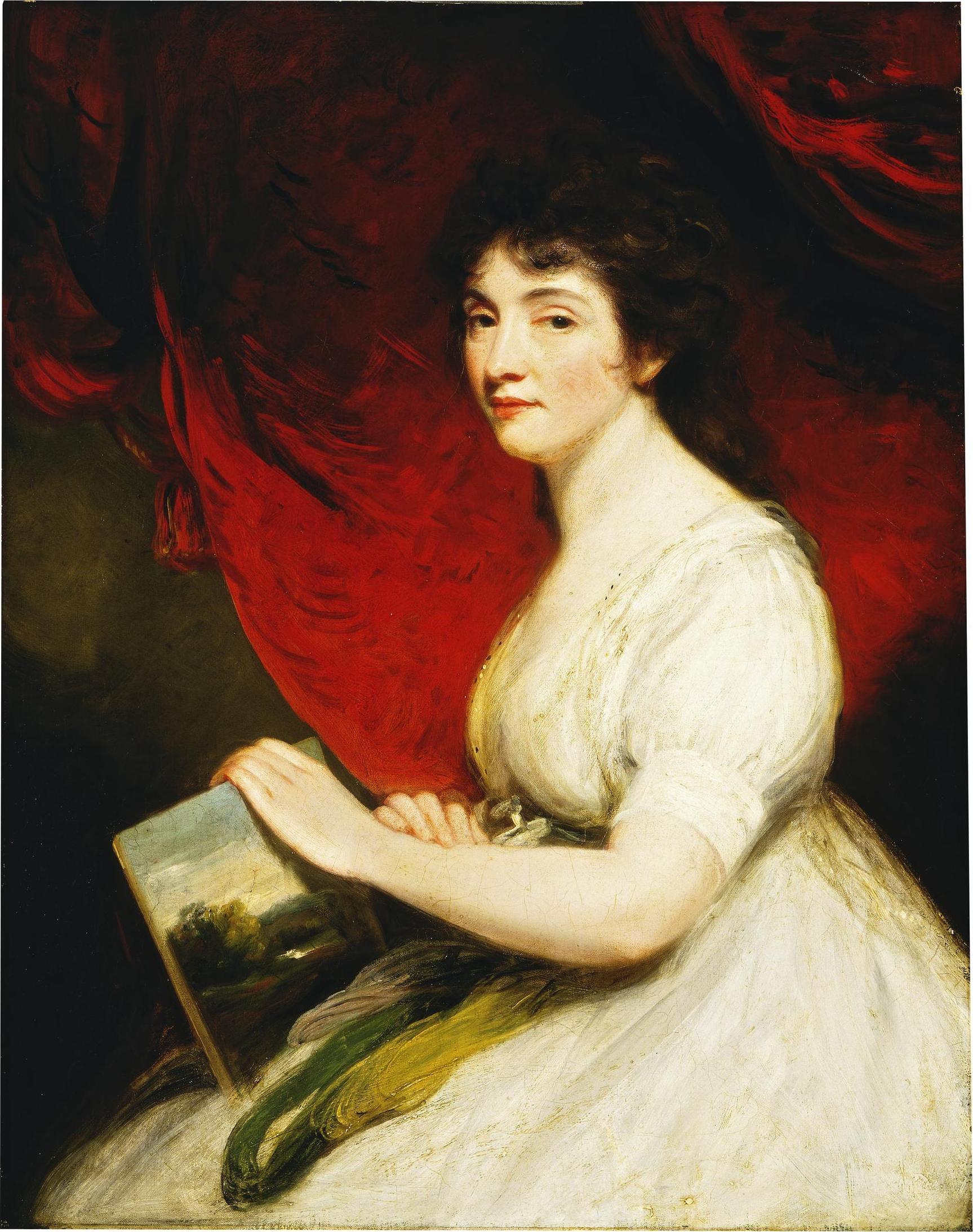 |
| Mary Linwood by John Hoppner |
Another account of Mary's Russian venture tells of a single picture being presented to the Tsarina, who commanded it be bought. The nobleman in charge of the purchase died before the agreed £ 3,000 was paid. Sadly, no one dared mention the deceased’s name, or anything associated with it, to the distraught empress. Therefore, Linwood’s needlework picture remained in Russia, unpaid for. Presumably, it is still there, somewhere.
To put Mary
Linwood’s commercial success into context, Catherine the Great’s offer equaled £4.2
million in today’s purchasing power. Indeed, the amount claimed
for the single work, £315,000 today, would put Linwood on par with Banksy. And
imagine, I had never heard of Mary Linwood.
The art world can be fickle. Masterpieces of one year are banished to attics or sheds, awaiting rediscovery at car boot sales. After her death, Christie’s auctioned Mary Linwood’s remaining embroideries for £300 pounds, still a whopping £25,900, today. Thankfully, the canvases have found their way into the collection Victoria and Albert Museum (V&A) and the Leicester City Museum .
With this background
information crammed into my head, one Sunday morning in August, I headed off to
Tate Britain to see Mary Linwood’s work, not online, not on print, but in situ. The real deal.
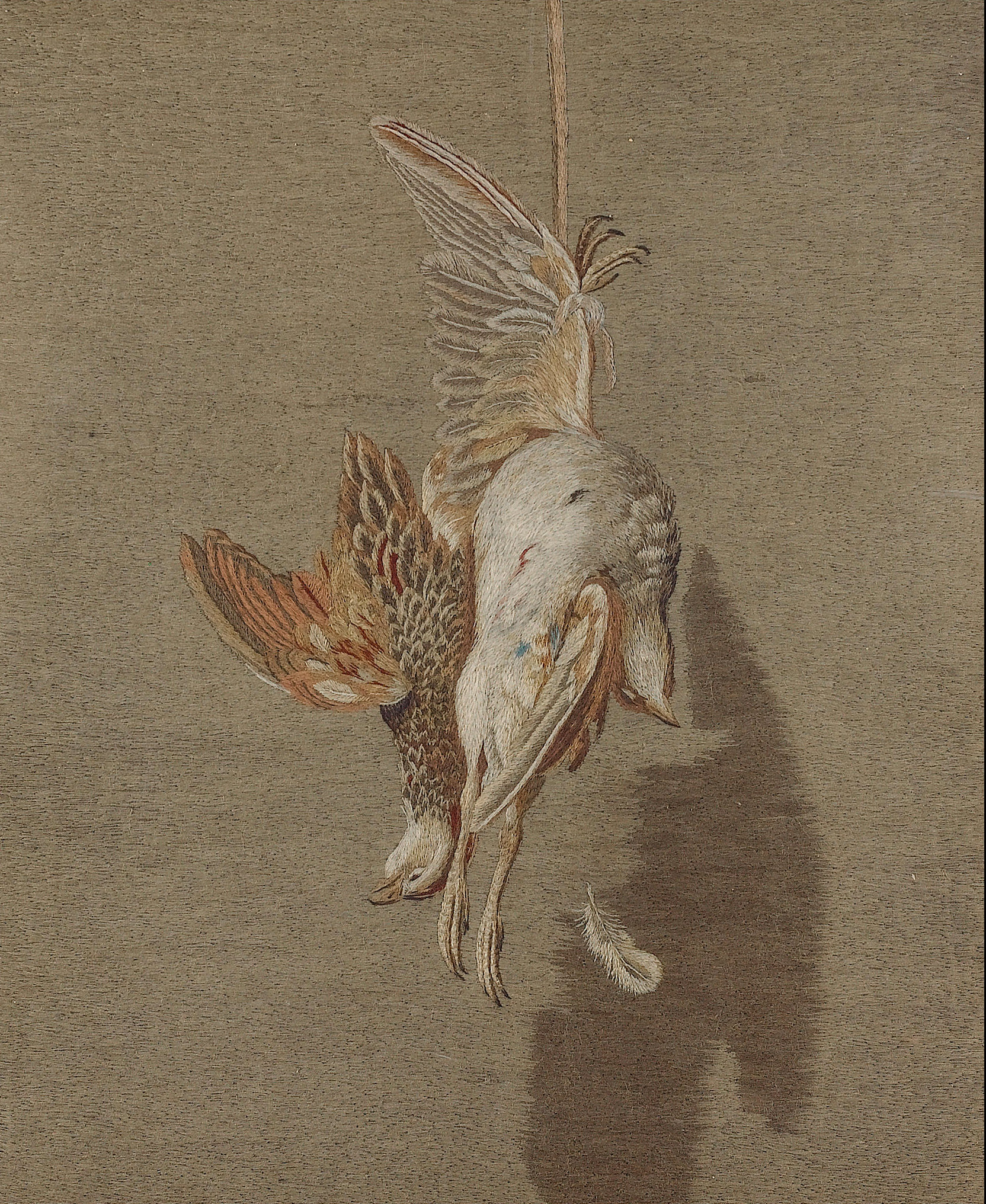 | |
| Hanging Partridge by Mary Linwood |
As a needle
painter of portraits, I was very intrigued to discover for myself how Mary Linwood approached
background, stitching direction, and shading. How realistic was her figurative
work? How had she balanced the classic techniques of needlework with the
demands of figurative art?
I make this point because some contemporary needle painters whom I have come across are not interested in stitching “classically” or “neatly.” Effect and image are paramount to them. In my own work, I try to reconcile image with stitching “tradition.” Neither approach is right, neither is wrong. It is the artistic difference, for example, between Ingres and -- here I go again -- energetic Van Gogh or Matisse. It‘s about what pleases the eye of the of the stitcher and viewer.
Cutting to the chase, I can tell you I was startled by what I saw. Linwood’s canvases hung in a corner galley, separated from the ships’ figureheads, quilts, and straw work. Dimly illuminated, undoubtedly to protect them, the portraits looked ethereally pale. Maybe my impression was jaded by the bright colors of wools available today. Linwood's yarns would be colored by natural materials, making them less vibrant than today’s artificial dye.
There was absolutely no doubt that Linwood's images might be created in anything but yarn. There was no illusion of pencil or pastel, let alone aquarelle or paint. They were "robust". l understand Linwood's choice of wool. It had several advantages. Its softness made blending stitches easier. Its denier made covering canvas quicker than fine silk or cotton. Moreover, wool was likely to have been less expensive thank silk.
Linwood relied on cream wool to render flesh, adding maybe a bit of rose for blush. The skin on her subjects looked dingy. Could the dyed yarns have faded in the intervening 200 odd years since she stitched them? (Copes at the V&A stitched in silk over 500 years ago are still vibrant.) Had London’s famed smog gotten to them? Or maybe I needed to remember that women used face power liberally to appear like porcelain. Whatever, This left the portraits, as I saw/experienced them, ghostly and missing dimension that the tone can create. Clothing was stitched in indigo and chocolate browns. The palette lacked the depth and vibrancy of paint or pastel by a long shot.
Nevertheless, Linwood did render facial topography well. I recognized her technique of using swirls of precise stitches over the cheekbones and across the nose to create interest and depth in a face. And diminutive precise stitches rendered the eyes, complete with light flecks. The surface the she created was even. In addition, there were longer stitches for the background to hurry the work to completion. The stitching was lovely. Yes, Mary had approached the problem of rendering figures much as I had taught myself to do.
Mary Linwood could draw well. As we see she transferred an accurate cartoons faithfully onto linen cloth for stitching. Her figures and images were excellently proportioned. I cannot draw, but am
blessed with technological advantages. I can print my subjects onto silk. What’s
more, I can choose from 400+ colors of cotton or silk. As I work, I stare at a
computer screen, which enlarges any area I struggle to understand. I wonder how much access Mary Linwood had to
the pictures she was replicating. More than likely, she encountered them in the
houses of people in her social circle. Still, I doubt she could camp in someone’s study
for weeks or months, surrounded by stitching paraphernalia. No, she would need
to work from sketches and memory. That she produced such faithful work under
these circumstances is remarkable. Maybe Linwood had a photographic memory. I wonder if she had a clutch of helpers to do boring backgrounds.
What I
found most unsettling was my response to the Linwood work. I appreciated it,
but I did not like it. That reaction startled me. Granted, the subject matter
was dated. Then so were the baroque designs in silk elsewhere in the exhibit. In
fact one of the most interesting, and beautiful things I saw as an embroidered
map of an estate property. It was colorful, it was clever, and it was a copy.
So why did I like it and not Linwood’s work? I am still pondering that
question.
Perhaps it is because Linwood’s work led me to understand why some subjects are not smitten by my early portraits. I get it now. My first ones are “neat and correct”, but they don’t “live”. They reflect little about my subjects. The portraits are emotionally neutral and, to boot, they are “pale,” almost
ethereal, ghostly. This saps them of “realism.” Or is it “life?”
It amazed me that I could admire everything that Mary Linwood had achieved personally, commercially and technically, but I still was not drawn to her work. I am glad it has a home in the V&A Museum. The pieces are important on many reason. Consider what they tell us about Mary Linwood as a person and entrepreneur. She achieved international acclaim without Facebook or internet. She openly copied the works of major artists of her era and was commended for it by the analog of the Royal Academy. (How amazing is that today, when copyright issues are made so much of.)
The medal Linwood received read: “EXCELLENT
IMITATIONS OF PICTURES IN NEEDLEWORK.” So maybe it’s that imitation that got to
me. For me, Linwood's works do not stand on their own. Clearly they did for her contemporaries. The needlework imitates the subject of
painting cleverly. And perhaps that is why, after a comet of a career, she is
remembered in a craft exhibition for technical prowess, and not an artistic retrospective. I found
that sobering but instructive.
PS Added; April 2015
A UK visitor to The BBC's Antinques Road show broadcast last night, brought along picture by Mary Linwood. It was valued at 3,000-4000 UK pounds.
PS Added; April 2015
A UK visitor to The BBC's Antinques Road show broadcast last night, brought along picture by Mary Linwood. It was valued at 3,000-4000 UK pounds.


